What Is DPF Regen?

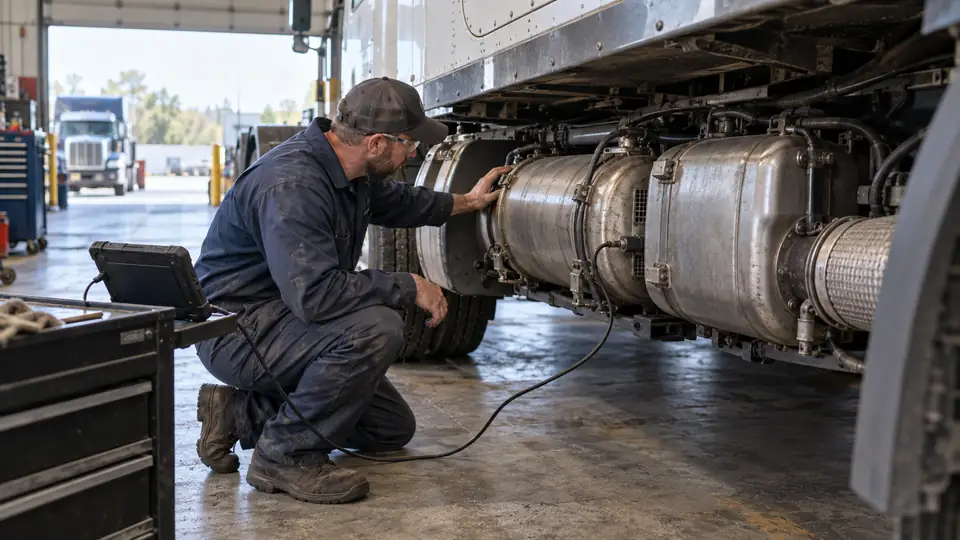
DPF regen, short for diesel particulate filter regeneration, is the process a diesel engine uses to remove accumulated soot from its exhaust filter. The engine and aftertreatment system raise the exhaust temperature enough to burn much of that soot, restoring space in the filter for continued operation.
A diesel particulate filter, or DPF, traps soot produced during combustion. Without regeneration, the filter would gradually restrict exhaust flow. Regeneration reduces soot loading, but it does not remove the noncombustible ash that accumulates over the life of the filter.
How DPF Regeneration Works
The engine control system monitors conditions such as exhaust temperatures, pressure across the DPF, engine operation, and estimated soot loading. When regeneration is needed and the required conditions are available, the system raises exhaust heat and manages fuel injection and other engine parameters to support soot oxidation.
The process may occur in several ways:
- Passive regeneration: Exhaust temperatures become high enough during normal driving or heavy engine operation to burn soot without a separate driver command.
- Active regeneration: The engine or aftertreatment controls deliberately increase exhaust temperature when the system determines that passive cleaning is insufficient.
- Parked or forced regeneration: A supported service procedure initiates regeneration while the truck is stationary. The exact name and availability vary by truck, engine, ECU, software, and diagnostic tool.
These terms describe different operating methods. They should not be treated as interchangeable. A truck may perform automatic active regeneration during operation, while a service technician may use a scanner to start a parked regeneration after checking the system.
Why a Truck Needs DPF Regen
Short trips, extended idling, light loads, low exhaust temperatures, and repeated interruptions can reduce the opportunity for natural soot removal. As soot accumulates, the engine control system may request an active regeneration or display an aftertreatment warning.
A loaded DPF can create increased exhaust backpressure. If the system cannot complete regeneration or detects a related fault, the truck may limit engine performance or enter a derate strategy. The exact warning messages and operating response depend on the vehicle and engine manufacturer.
Regeneration addresses soot loading. It does not automatically correct problems such as a failed temperature sensor, damaged wiring, an exhaust leak, an injector issue, an air-management fault, or a DPF that is physically damaged or ash-loaded.
What Happens to Soot and Ash?
| Material | What happens during regeneration | Diagnostic significance |
|---|---|---|
| Soot | Much of it is oxidized at elevated exhaust temperature. | High soot loading may trigger an automatic or service regeneration. |
| Ash | It remains in the filter because it does not burn away through normal regeneration. | High ash accumulation may require a separate cleaning or replacement decision. |
Soot and ash are therefore separate issues. A completed regeneration can reduce soot while leaving ash in place. A scanner may report estimated soot load, ash-related information, regeneration status, or related pressure data, but the available data depends on the truck and diagnostic software.
What a Truck Scanner Can Show
DPF-related scanner coverage ranges from basic fault-code access to manufacturer-specific service functions. Depending on the application, diagnostic software may display:
- DPF-related diagnostic trouble codes
- Estimated soot load or filter loading status
- Differential pressure across the DPF
- Exhaust temperature sensor readings
- Regeneration status and history
- Aftertreatment system data
- Conditions preventing a regeneration request
- A supported parked or forced regeneration command
These functions are separate. A scanner that reads DPF fault codes may not display all live data, and DPF diagnostics do not automatically establish support for a forced regeneration. Service-function access may depend on the truck make, model year, engine, ECU, software version, scanner coverage, and required licensing.
A physical connector or protocol listing does not prove that a scanner can perform regeneration. The vehicle-side connection, communication support, ECU coverage, diagnostic software, and specific service function all have to align.
DPF Regen Versus Related Aftertreatment Functions
Aftertreatment systems often include several separate functions. Confusing them can lead to an incorrect diagnostic decision.
- DPF diagnostics: Reading codes and viewing available data related to the particulate filter.
- DPF reset: Clearing or updating a learned service value after an approved repair or filter service. This does not clean the filter.
- DPF regeneration: Burning accumulated soot from the filter.
- Forced regeneration: A scanner-assisted or manufacturer-supported command that initiates a regeneration under specified conditions.
- SCR and DEF diagnostics: Testing or analyzing the selective catalytic reduction system and diesel exhaust fluid functions.
- NOx and derate diagnostics: Investigating emissions sensors, control strategies, and reduced-power responses.
Access to one of these functions does not prove access to the others. For example, a tool may read DPF codes but lack a regeneration command, or it may support a regeneration command on some engines and not others.
Why a Regeneration May Not Start or Complete
A regeneration request can be rejected, interrupted, or stopped because the vehicle does not meet the applicable conditions or because the system has detected a fault. Common areas to investigate include:
- Active engine or aftertreatment fault codes
- Temperature sensor or differential-pressure sensor faults
- Wiring, connector, or exhaust problems
- Insufficient exhaust temperature during operation
- Fuel or engine-management issues that increase soot production
- High ash accumulation or a restricted filter
- Incorrect vehicle or engine selection in the diagnostic software
- Scanner software that lacks the required regeneration function
The code or data provides a direction for testing, but it does not automatically identify the failed component. A high pressure reading, for example, may relate to filter loading, sensor accuracy, plumbing, or another exhaust problem. Related live data, service information, inspections, and supported tests may be needed.
Can a Scanner Start DPF Regen?
Sometimes. A compatible heavy-duty scanner or manufacturer diagnostic system may offer a parked or forced regeneration function for selected trucks and engines. Availability is application-specific, and a tool menu labeled “DPF service” does not guarantee that every regeneration procedure is supported.
Before using a scanner-assisted regeneration, identify the exact truck, model year, engine, ECU, and aftertreatment system. Confirm that the software lists the required service function. Follow the scanner instructions, vehicle-specific service information, and applicable shop safety procedures. A regeneration produces very high exhaust temperatures, so the surrounding area and vehicle condition must be suitable for the procedure.
Do not repeatedly command regeneration to eliminate a warning without finding out why the system requested it. A regeneration may temporarily reduce soot while an underlying sensor, fueling, exhaust, or engine fault remains unresolved. If the truck has severe warnings, abnormal operation, or an uncertain safety condition, the scanner result should not be used as proof that continued driving is appropriate.
What DPF Regen Does Not Prove
A completed regeneration does not prove that the DPF is clean of ash, that the filter is undamaged, or that the entire aftertreatment system is operating correctly. It also does not prove that a related fault has been repaired. The truck’s control system must continue monitoring the filter and its sensors after the event.
For that reason, DPF regeneration is best understood as one aftertreatment operation within a larger diagnostic process. The useful question is often whether the truck can complete regeneration and why it requested one, rather than simply whether a scanner can start the procedure.

- Caleb
Caleb writes about heavy-duty truck scanners, diagnostic tools, vehicle compatibility, and related technologies for Best Truck Scanners. His work focuses on making product specifications and diagnostic features easier to understand and compare.
- Best J1939 Diagnostic Adapter: 9 Picks in 2026 November 14, 2026
- 6-Pin vs 9-Pin Truck Diagnostic Connector: Key Differences Explained November 12, 2026
- Best Scanner for Cummins X15: 9 Picks in 2026 November 10, 2026
- Best Scanner for PACCAR MX-13: 9 Picks in 2026 November 8, 2026
- SPN vs FMI: Understanding Heavy-Duty Diagnostic Fault Codes November 6, 2026