Best Semi Truck Diagnostic Scanner: 9 Picks in 2026

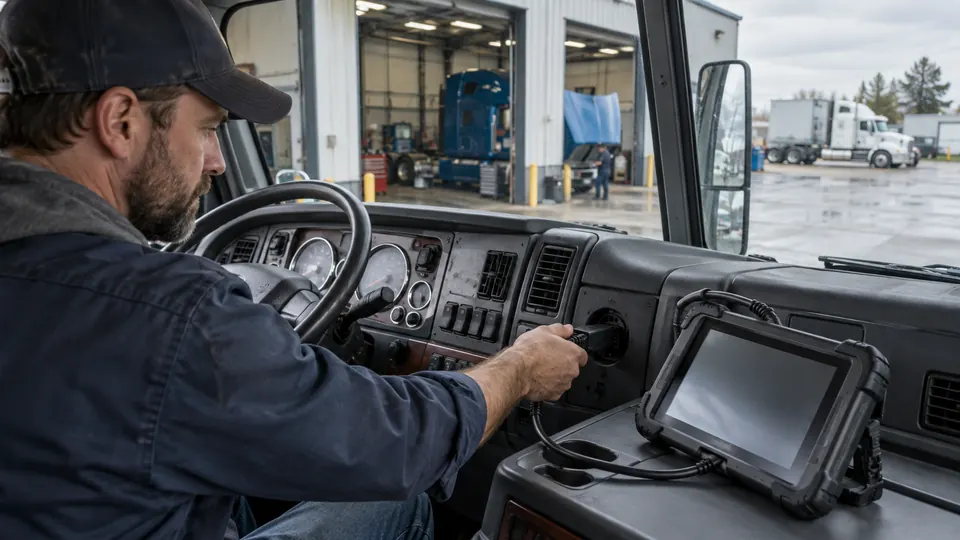
A semi truck diagnostic scanner has to answer more than a glowing warning light. The useful tool is the one that can communicate with the truck’s heavy-duty systems, work with the correct connector and protocol, show live information, and provide enough system access to guide the next repair decision. A scanner may list J1939, J1708, or 9-pin support, yet that alone does not prove coverage for every engine, model year, ECU, or service function.
The biggest buying trap is treating broad brand lists and feature counts as universal compatibility. Code reading, full-system scanning, DPF diagnostics, forced regeneration, bidirectional tests, ECU coding, and parameter adjustments are separate capabilities. For example, a scanner that reads DPF fault codes may not perform a regeneration, while a tool with bidirectional control may offer active tests only on selected vehicles and modules. The ANCEL X7HD PRO is the strongest overall choice here because its published feature set combines heavy-duty system diagnostics, service functions, active tests, and ECU coding in one tablet.
The nine options below cover several sensible approaches. Some are compact tools for roadside code checks, some focus on Detroit and PACCAR aftertreatment work, and others are deeper diagnostic tablets for mixed fleets or repair facilities. Match the scanner to the truck’s make, model year, engine, connector, and required task before ordering.
Quick Answer
- Best Overall: ANCEL X7HD PRO for broad heavy-duty diagnostics, service functions, active tests, and ECU coding.
- Best Premium Alternative: ANCEL V6HD for bidirectional testing, aftertreatment data, and a large adapter package.
- Best Mid-Range DPF Choice: ANCEL HD3400 Pro for supported forced regeneration, full-system checks, and reporting tools.
- Best Compact Detroit and PACCAR Option: ANCEL HD431 for listed Detroit and PACCAR DPF functions in a standalone handheld format.
Best Semi Truck Diagnostic Scanner Comparison Table
| Product | Best For | Diagnostic Depth | Key Functions |
|---|---|---|---|
| ANCEL X7HD PRO | Mixed fleets and repair shops | Full-system diagnostics | 42+ functions, active tests, ECU coding |
| ANCEL V6HD | Advanced aftertreatment work | Full-system and bidirectional | DPF, DEF/SCR data, 40+ service functions |
| ANCEL HD3400 Pro | DPF service and fleet checks | Full-system diagnostics | DPF regen, topology, reports |
| Launch CRP129HD | DPF regen and service resets | Full-system diagnostics | Forced regen, injector coding, DEF test |
| ANCEL HD431 | Detroit and PACCAR trucks | Full-system diagnostics | Forced DPF regeneration, 6/9/16-pin support |
| ANCEL HD110 | Detroit and PACCAR engines | Multi-system diagnostics | DPF regen, live data, lifetime updates |
| FOXWELL HD500 | Injector and speed-limit checks | Multi-system diagnostics | DPF regen, injector cutoff, ABS bleeding |
| ANCEL HD601 | Everyday truck code checks | Full-system diagnostics | J1939, J1708/J1587, live data, DTC lookup |
| NEXAS NL102 | Basic fleet troubleshooting | Full-system general diagnostics | Code reading, clearing, live data |
The detailed reviews explain where each scanner fits, which capabilities are clearly listed, and where vehicle-specific verification remains necessary.
1. ANCEL X7HD PRO — Best Overall
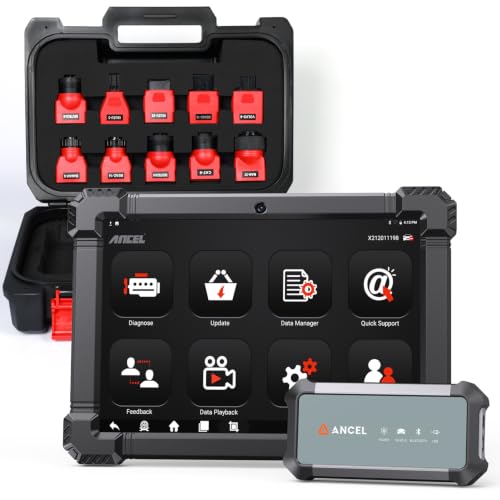
The X7HD PRO earns the top spot because its published capabilities cover the parts of semi truck diagnostics that basic code readers leave out. It lists full-system access for supported Engine, Transmission, ABS, and Body systems, along with live data, freeze-frame information, and HDOBD and OBD2 support. That gives it a broader role than a simple engine warning-light reader, especially for a shop or fleet handling several truck brands.
The deeper advantage is the combination of 42-plus service functions, bidirectional controls, and ECU coding. The listing identifies supported tasks such as DPF regeneration, injector coding, oil reset, ABS bleeding, throttle adaptation, and idle or speed adjustment. Its active-test capability is described for supported components and systems, so buyers should still verify the exact truck and ECU before expecting a particular test. The 10.1-inch Android display, live-data recording, report saving, Wi-Fi, Bluetooth, and 6,000mAh battery make it better suited to extended diagnostic sessions than a tiny handheld reader.
Pros
- Full-system diagnostics for supported heavy-duty trucks.
- 42-plus listed service and reset functions.
- Bidirectional controls and active tests are included in the product description.
- ECU coding, module matching, adaptations, and relearn functions are listed.
- Large 10.1-inch screen with live-data recording and report support.
Cons
- Two years of free updates is shorter than the lifetime-update policy listed for some simpler scanners.
- Advanced functions remain dependent on truck, engine, model year, and ECU support.
This is the strongest fit for a mixed-fleet maintenance operation that needs one tablet for diagnosis, service work, and post-repair procedures. It may be more tool than a single truck owner needs, particularly if the main task is reading and clearing codes at the roadside. Buyers should verify the required function before purchase, since a feature appearing in the general specification does not guarantee availability on every compatible vehicle.
To buy this product, click here.
2. ANCEL V6HD — Best Premium Aftertreatment and Active-Test Tool

Aftertreatment troubleshooting is the defining reason to choose the V6HD. The product information lists DPF regeneration plus data for soot load, differential pressure, exhaust temperature, NOx sensors, and DEF level. That combination can help a technician examine the conditions around a warning or derate instead of relying on a single fault code. The scanner is also listed for major truck and engine brands, including Freightliner, Kenworth, Peterbilt, Mack, International, Volvo, Cummins, Detroit, PACCAR, and Caterpillar.
Its bidirectional tools add another layer. The listing describes commands and monitoring for supported injectors, EGR or VGT actuators, cooling fans, fuel pumps, and relays, along with cylinder cut-off testing. Those details make the V6HD more attractive for fault isolation than a tool limited to reading and clearing codes. The included adapter kit is unusually broad, with ten dedicated adapters for applications such as CAT, Isuzu, Volvo, Scania, DAF, Mercedes-Benz, Deutsch 6-pin, Deutsch 9-pin, and MAN. Coverage still depends on the specific vehicle and system, but the hardware package is built for varied commercial applications.
Pros
- Lists DPF regeneration and DEF/SCR diagnostic data.
- Bidirectional testing includes several supported component categories.
- More than 40 diesel service functions are identified.
- Includes ten dedicated heavy-duty adapters.
- 8-inch display and wireless VCI support shop and field use.
Cons
- Free official software updates are listed for two years, not indefinitely.
- The broad adapter kit does not remove the need to verify exact vehicle and ECU coverage.
The V6HD suits repair facilities that regularly move between truck brands and need deeper aftertreatment information. It is a premium purchase for a reader that only needs occasional engine-code checks, and the more advanced functions may require familiarity with the vehicle’s service requirements. Choose it over the X7HD PRO when the adapter range and listed DPF, DEF, and active-test focus carry more weight than ECU coding breadth.
To buy this product, click here.
3. ANCEL HD3400 Pro — Best Mid-Range Fleet Diagnostic Scanner

The HD3400 Pro takes a practical middle path. Its listed coverage includes Cummins, PACCAR, Caterpillar, Detroit, Volvo, Mack, International, Freightliner, Peterbilt, Kenworth, and Western Star applications, with HDOBD and OBD2 support through 6-pin and 9-pin connections. It also lists DPF forced regeneration and reset functions for supported applications. That combination gives a fleet more diagnostic reach than a basic code reader without moving immediately to the most expensive tablet class.
What makes this model particularly useful for organized maintenance is its documentation focus. Topology display, wiring diagrams, Pin Detect, and pre-scan and post-scan reports are listed among its tools. Those features can help show which systems are involved, identify possible connector or wiring issues, and record the condition before and after service. The product information also warns that regeneration may be unavailable on newer Detroit-powered trucks using UDS, including some Freightliner Cascadia models. That limitation is significant for buyers who maintain newer Detroit equipment.
Pros
- Lists DPF forced regeneration and reset functions.
- Supports multiple heavy-duty truck and engine applications.
- Topology display and wiring diagrams support fault tracing.
- Pre-scan and post-scan reports help document service work.
- Free software updates are listed for the life of the device.
Cons
- Some newer Detroit applications using UDS may not support DPF regeneration.
- Wiring diagrams are identified for Cummins engines only.
The HD3400 Pro is a sensible choice for a small fleet or service operation that values reports and practical DPF functions. Buyers focused on active tests, ECU coding, or a larger adapter set may prefer one of the higher-ranked tablets. Anyone working on a newer Detroit-powered truck should check the exact engine, protocol, and requested regeneration function before treating the advertised DPF capability as a match.
To buy this product, click here.
4. Launch CRP129HD — Best for DPF Regen and Service Resets

The CRP129HD is centered on service procedures rather than basic fault-code access. Its product information specifically lists forced DPF regeneration, DPF reset, and DPD or DPR functions. It also identifies oil reset, injector coding, DEF testing, speed-limit adjustment, cylinder cutout, and clutch relearn among its service tools. This makes the scanner attractive for users who need a practical way to handle selected maintenance tasks after confirming compatibility.
Its diagnostic coverage extends across Engine, ABS, Transmission, SRS, SAS, TPMS, and other listed systems, with live data, freeze-frame information, and DTC lookup. J1939, J1708, J1587, OBD2, and CAN protocols are listed, along with compatibility across many mainstream truck and engine brands. Built-in remote support through TeamViewer is another unusual feature, although the exact help available for a particular fault depends on the vehicle and support process. The two-year update period should be weighed against scanners that list lifetime updates.
Pros
- Clearly lists forced DPF regeneration and DPF reset functions.
- Includes more than seven service and reset functions.
- Supports multiple heavy-duty protocols and broad brand coverage.
- Provides live data, freeze frame, and multi-system diagnostics.
- Remote diagnostic support is included in the product description.
Cons
- Free Wi-Fi updates are listed for two years.
- Specific service functions vary by vehicle model and require compatibility checking.
This model fits a buyer who has a clear need for DPF work, injector coding, or selected reset procedures and wants a tablet with broader system access. It is less compelling for someone who wants a small, glove-box code reader or lifetime updates above all else. The listing’s broad brand coverage should be treated as a starting point, not proof that every listed function works across every engine.
To buy this product, click here.
5. ANCEL HD431 — Best Compact Detroit and PACCAR Scanner

The HD431 is a focused choice for Detroit and PACCAR work. The listing identifies forced DPF regeneration for engines including Detroit DD13, DD15, and DD16, as well as PACCAR PX-7, PX-9, MX-11, and MX-13. It also describes coverage for 6-pin, 9-pin, and OBD2 16-pin connections. For a driver who wants a standalone device rather than a phone-dependent interface, the 4.3-inch display and physical buttons offer a straightforward roadside format.
There is useful detail in the operating design. Quick Scan and Complete Scan modes are listed, along with code reading, code clearing, live data, ECU information, and diagnostic report storage. The product information also claims support for newer Detroit trucks using UDS, including some 2022-and-newer applications. Since model year, ECU version, and protocol can affect function availability, that claim still deserves confirmation for a specific truck. The compact format gives up the larger screens and deeper service menus found on the tablet-style options above.
Pros
- Lists forced DPF regeneration for specified Detroit and PACCAR engines.
- Supports 6-pin, 9-pin, and OBD2 16-pin connections.
- Standalone operation does not require a phone for the scanning interface.
- Physical buttons and glare-resistant display suit roadside use.
- Free Wi-Fi updates are listed for the life of the device.
Cons
- Its smaller screen is less suited to extended live-data analysis than a 10.1-inch tablet.
- Exact coverage can vary by model year, ECU version, protocol, and function.
The HD431 makes the most sense for a truck owner whose main concern is supported Detroit or PACCAR diagnostics and DPF regeneration in a compact package. A mixed-brand repair shop may need the broader system access, active tests, or adapter range of a premium tablet. Confirm the engine and protocol before relying on the advertised regeneration feature, especially for newer Detroit applications.
To buy this product, click here.
6. ANCEL HD110 — Best Lower-Cost Detroit and PACCAR DPF Tool

The HD110 is a narrower alternative to the larger diagnostic tablets. Its stated focus is compatible Detroit and PACCAR engines, with the listing naming DD13, DD15, DD16, PX-7, PX-9, MX-11, and MX-13. It lists DPF regeneration and system access for Engine, Transmission, DPF, ABS, and Fuel. That makes it relevant for routine checks and aftertreatment work where the truck falls within the supported application range.
Read and clear codes, live data, freeze-frame information, and DTC lookup give the scanner a useful everyday role. The product information also lists Bluetooth and Wi-Fi, 9-pin and 16-pin adapters, and support for several heavy-duty and OBD-related protocols. It is more portable than a full diagnostic tablet, though the supplied information does not describe the same active-test, ECU-coding, or reporting depth found on the premium models. The lifetime update claim is appealing, but it applies to supported coverage and software rather than guaranteeing every future vehicle function.
Pros
- Lists DPF regeneration for supported Detroit and PACCAR applications.
- Names specific Detroit and PACCAR engine families.
- Accesses several truck systems beyond the engine module.
- Includes 9-pin and 16-pin adapters.
- Free lifetime software updates are listed without recurring subscription fees.
Cons
- Its stated engine focus is narrower than the broad mixed-fleet tablets.
- The product information does not list bidirectional controls or ECU coding.
This is a good fit for a buyer who has a compatible Detroit or PACCAR truck and wants DPF-related capability without stepping up to a large tablet. It is less suitable for a repair shop that needs active tests, module coding, or a wide range of dedicated adapters. Verify the exact engine, truck configuration, and required DPF procedure before purchase.
To buy this product, click here.
7. FOXWELL HD500 — Best for Injector Cutoff and Fleet Parameters

The HD500 brings a different emphasis to the comparison. Along with multi-system diagnostics and DPF regeneration on supported vehicles, its listing identifies injector cutoff testing and speed-limit setting. Injector cutoff can help compare RPM response between cylinders on compatible engines, while the speed-limit function is aimed at supported vehicle and engine parameters. Those are specialized tools that may matter more to a fleet maintenance program than another generic code-clearing feature.
The scanner also lists live data for information such as RPM, coolant temperature, fuel pressure, boost, DPF pressure, and NOx, plus access to Engine, ABS, SRS, parking brake, and DPF or aftertreatment systems. J1939 and J1708/J1587 support are identified, and the package includes 6-pin, 9-pin, CAT 9-pin, CAT 14-pin, and 16-pin adapters. The listing specifically excludes DPF regeneration support on Isuzu vehicles and warns that speed-limit functions vary by engine and VIN, so those limitations should shape the purchase decision.
Pros
- Lists DPF regeneration on compatible vehicles.
- Includes injector cutoff for supported engines.
- Offers speed-limit setting and live aftertreatment data.
- Includes several heavy-duty connector adapters.
- Free lifetime software updates are listed without annual subscription fees.
Cons
- DPF regeneration is identified as unavailable on Isuzu vehicles.
- Speed-limit functions and other service features vary by engine and VIN.
The HD500 is most useful for a buyer who has a clear reason to use injector cutoff, supported speed-limit adjustment, or its broad adapter package. A general roadside user may find a simpler scanner easier to justify, while a full-service shop may prefer bidirectional control and ECU coding. Check the VIN and engine before relying on a parameter function, since physical connection alone does not establish access.
To buy this product, click here.
8. ANCEL HD601 — Best Everyday Full-System Reader

The HD601 is aimed at everyday diagnostics across heavy-duty trucks and commercial vehicles. Its listing identifies full-system scanning for supported Engine, Transmission, ABS, and other systems, along with Quick Scan, Full Scan, live data, freeze-frame information, and code reading and clearing. It supports both HDOBD and OBD2, so it can serve a mixed role for commercial vehicles and compatible light-duty vehicles, although the listing limits light-duty coverage to OBD2 diagnostics.
J1939 and J1587/J1708 support are clearly listed, as are 6-pin, 9-pin, and 16-pin connectors. The built-in DTC library and manual SPN and FMI lookup can be useful when a roadside warning appears far from a shop or internet connection. This is a more straightforward diagnostic tool than the tablet-style models, and the product information does not list forced DPF regeneration, bidirectional tests, or ECU coding. Its strength is broad routine access and lifetime updates rather than advanced service procedures.
Pros
- Supports listed J1939 and J1587/J1708 heavy-duty protocols.
- Provides full-system scanning for supported truck systems.
- Includes 6-pin, 9-pin, and 16-pin connection support.
- Built-in DTC, SPN, and FMI lookup aids roadside code interpretation.
- Lifetime free updates are listed.
Cons
- The product information does not list DPF regeneration, ECU coding, or bidirectional controls.
- Exact coverage varies by model year, system, and vehicle configuration.
The HD601 is a reasonable choice for an owner who wants more than passenger-car OBD2 but does not need a service tablet. It can help identify which system has reported a fault and provide live information for the next repair decision. Buyers who specifically need DPF regeneration or component activation should move higher in the list rather than expecting the HD601’s full-system wording to cover those procedures.
To buy this product, click here.
9. NEXAS NL102 — Best for Straightforward Code and Live-Data Checks

The NL102 keeps its role clear. The listing describes reading and clearing fault codes, live-data streaming, built-in fault-code definitions, and full-system general diagnostics for many Class 4 through Class 8 diesel trucks. Listed applications include Freightliner, Peterbilt, Kenworth, Volvo, Mack, and Cummins-powered vehicles. For a truck owner who mainly wants to understand a warning light and review current engine information, that is a useful starting point.
Simple menus and on-device DTC explanations are the practical appeal. A user does not have to carry a separate code reference just to interpret the first diagnostic result, and lifetime updates are listed alongside technical support. The important boundary is equally clear: the product information specifically says DPF regeneration is available on the NL102P or NL102 Plus models, not this NL102. That makes the standard NL102 a general diagnostic reader rather than a DPF regeneration choice.
Pros
- Designed for listed Class 4 through Class 8 diesel truck applications.
- Reads and clears codes across supported systems.
- Provides live data and built-in fault-code explanations.
- Simple menus suit routine diagnostic checks.
- Free lifetime updates and technical support are listed.
Cons
- The standard NL102 does not list DPF regeneration; that function is identified for other NL102 versions.
- The product information does not list bidirectional controls or ECU coding.
The NL102 works best as a straightforward first diagnostic step for common warning-light and live-data questions. It is less appropriate for aftertreatment service, module coding, or advanced active tests. Confirm that the standard NL102, rather than an NL102P or NL102 Plus variant, is the model being purchased if DPF regeneration is part of the requirement.
To buy this product, click here.
Buying Guide
Match the Scanner to the Exact Truck and Engine
A product page may list Freightliner, Kenworth, Detroit, Cummins, or PACCAR without proving coverage for every model, year, ECU, and function under that name. A Cascadia with one engine and protocol may present a different diagnostic situation from another Cascadia configuration. Before ordering, record the truck make, model, year, engine, diagnostic connector, and the task you need to perform. Ask about that exact combination rather than relying on a broad brand list.
Separate Connector Fit from Diagnostic Coverage
A 6-pin, 9-pin, or 16-pin adapter answers the physical connection question. It does not prove that the scanner can communicate with every module behind that connector. J1939, J1708, and J1587 are communication protocols, while the connector is the physical path into the vehicle. A scanner must support the relevant protocol and the vehicle’s systems for the connection to be useful.
Decide Whether You Need Codes, Live Data, or Service Functions
Basic code reading can identify a reported fault. Live data adds current operating information, while full-system diagnostics reach more than the engine module on supported vehicles. Service functions sit at another level. DPF regeneration, injector coding, speed adjustment, ABS bleeding, ECU coding, and active tests should be treated as separate requirements. The X7HD PRO, V6HD, Launch CRP129HD, and HD500 list deeper functions than the HD601 or NL102, but availability can still vary by truck and ECU.
DPF Diagnostics Do Not Always Mean Regeneration
Check the exact wording for the aftertreatment task. A scanner may read DPF codes or show soot and sensor data without initiating a regeneration. The HD431, HD110, HD3400 Pro, Launch CRP129HD, X7HD PRO, V6HD, and HD500 list regeneration capabilities, while the standard NL102 specifically does not list that function. A supported regeneration procedure also does not replace the vehicle’s service requirements or confirm that every DPF fault is appropriate for regeneration.
Bidirectional Control Has Vehicle and Module Limits
Active testing can send commands to supported systems and observe their response, which may help narrow down a fault before parts are replaced. It is not a universal pass to every actuator on every truck. The V6HD and X7HD PRO list bidirectional functions, while the supplied information for several less expensive models does not. Verify the particular test, engine, and module if that capability is central to the purchase.
Review Updates as Part of Ownership
Lifetime updates can be useful for a tool kept in a truck for several years, but the phrase still refers to supported software and coverage. Other models list two years of free updates, after which existing functions may remain available according to the product information. Compare the update period with the scanner’s diagnostic depth, and check whether the functions you need are included in the update policy rather than assuming every future feature is covered.
Choose Standalone Hardware or a Larger Tablet Deliberately
A compact handheld scanner can be easier to store in a cab and quicker to use beside the road. A 10.1-inch tablet gives more room for graphs, reports, menus, and extended service work. The HD431 and HD601 favor portability, while the X7HD PRO and X7HD offer a larger tablet approach. Neither format is automatically better. The right choice depends on whether the scanner will spend most of its life in a glove box or on a shop cart.
Best Semi Truck Diagnostic Scanner FAQ
What is the best semi truck diagnostic scanner overall?
The ANCEL X7HD PRO is the strongest overall option in this comparison because its listed capabilities include full-system diagnostics, 42-plus service functions, bidirectional controls, active tests, and ECU coding. It is a better fit for mixed fleets and repair operations than for someone who only needs occasional code reading. Confirm the exact truck and required function before purchase.
Is J1939 support enough to guarantee compatibility?
No. J1939 support identifies a communication capability, but it does not prove access to every truck, ECU, system, or service procedure. Physical connector fit matters too, and vehicle coverage can vary by model year, engine, and configuration. Treat J1939 as one part of the compatibility check.
Do all of these scanners perform DPF regeneration?
No. The supplied information lists regeneration for several models, including the X7HD PRO, V6HD, HD3400 Pro, Launch CRP129HD, HD431, HD110, and HD500. The standard NEXAS NL102 is described for code reading, live data, and general diagnostics, while DPF regeneration is identified for the NL102P or NL102 Plus versions. The HD601 listing does not identify forced DPF regeneration.
What is the difference between DPF diagnostics and DPF regeneration?
DPF diagnostics can include reading fault codes or viewing information such as soot load, pressure, temperature, and sensor status. Regeneration is a separate service action that burns accumulated soot under supported conditions. A scanner must specifically list the relevant regeneration function, and compatibility can still depend on the truck, engine, ECU, and protocol.
Are 6-pin and 9-pin adapters interchangeable?
No. They are different physical connector formats, and the correct one must match the truck’s diagnostic port. A connector adapter also does not prove that the scanner supports the communication protocol or systems behind it. Several scanners in this roundup list both 6-pin and 9-pin support, but exact application coverage still requires verification.
Do full-system scanners access every truck module?
No. “Full-system” describes the product’s intended diagnostic scope, but available systems depend on the vehicle and software coverage. A listing may identify Engine, Transmission, ABS, Body, or other systems while still limiting access by model year, ECU, or configuration. Read the product description as supported coverage, not a guarantee of universal module access.
Is bidirectional control the same as ECU programming?
No. Bidirectional control or an active test sends commands to supported vehicle components. ECU coding or module matching is a separate capability. The X7HD PRO and X7HD list both categories, but the presence of one should not be used to infer the other on a different scanner.
Should a single-truck owner buy a premium diagnostic tablet?
That depends on the work required. A compact HD431, HD110, HD601, or NL102 can make more sense for routine code and live-data checks, while the larger tablets are better suited to service procedures, active tests, reports, or mixed-vehicle work. If DPF regeneration, injector coding, or ECU-related functions are central, start with the exact supported task rather than screen size or brand count.
Final Verdict
The ANCEL X7HD PRO is the strongest overall semi truck diagnostic scanner in this group. Its combination of full-system access, 42-plus service functions, bidirectional controls, active tests, and ECU coding gives it the broadest practical role for a mixed fleet or repair shop. The ANCEL V6HD is the stronger premium alternative for buyers who place extra weight on aftertreatment data, bidirectional testing, and a broad dedicated adapter kit. For a mid-range route into DPF work and fleet documentation, the ANCEL HD3400 Pro offers a useful balance.
More focused needs point elsewhere. The HD431 and HD110 are attractive for supported Detroit and PACCAR applications, while the Launch CRP129HD suits buyers seeking DPF regeneration and multiple service resets. The HD601 and NEXAS NL102 are better matched to routine code, live-data, and system checks. Before buying, verify the exact truck, engine, model year, connector, protocol, and requested function. That short compatibility check matters more than a long list of advertised features.

- Caleb
Caleb writes about heavy-duty truck scanners, diagnostic tools, vehicle compatibility, and related technologies for Best Truck Scanners. His work focuses on making product specifications and diagnostic features easier to understand and compare.
- Best J1939 Diagnostic Adapter: 9 Picks in 2026 November 14, 2026
- 6-Pin vs 9-Pin Truck Diagnostic Connector: Key Differences Explained November 12, 2026
- Best Scanner for Cummins X15: 9 Picks in 2026 November 10, 2026
- Best Scanner for PACCAR MX-13: 9 Picks in 2026 November 8, 2026
- SPN vs FMI: Understanding Heavy-Duty Diagnostic Fault Codes November 6, 2026